
Blanching medium asparagus for 4 minutes in boiling water followed by a 4-minute ice bath stops enzyme activity that would otherwise turn your spears into limp, gray-green mush within 3 months of freezing.
Key Takeaways:
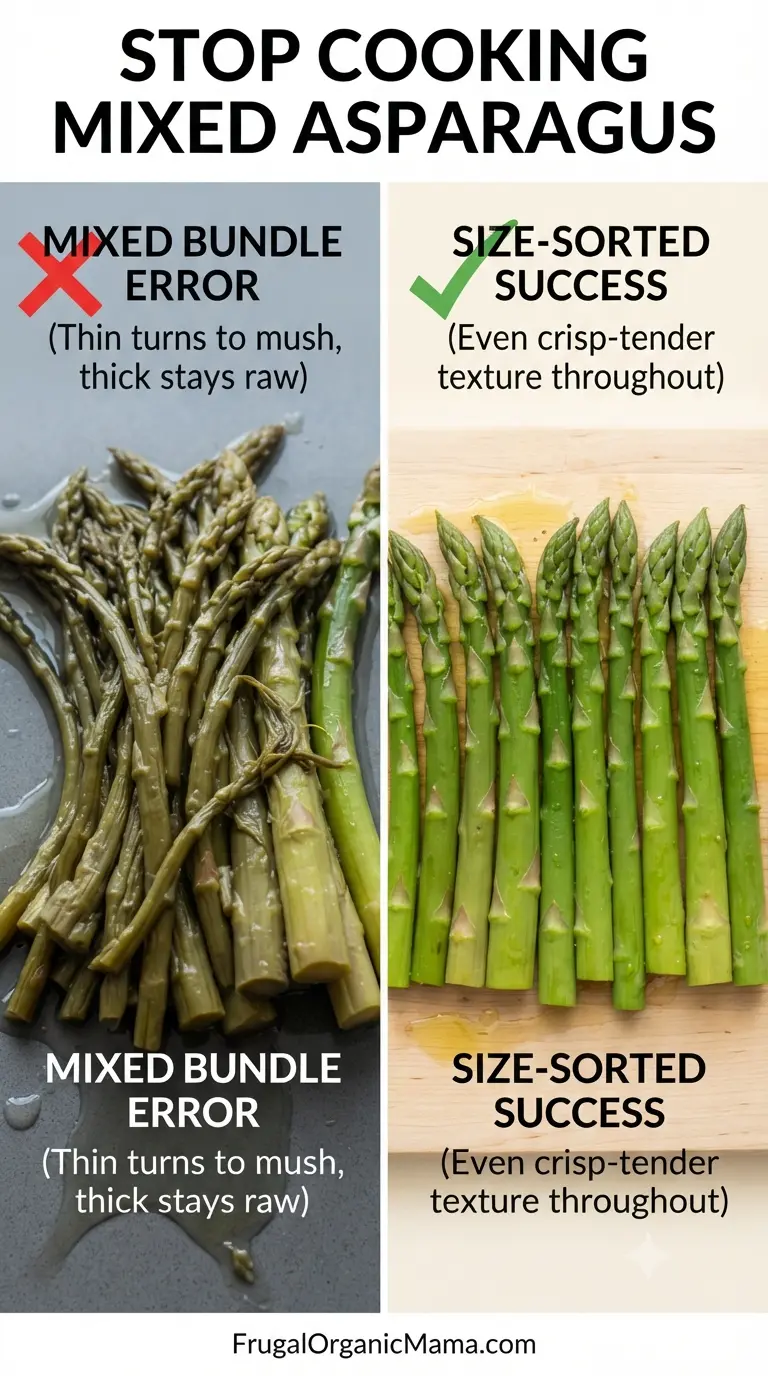
- Asparagus requires different blanch times based on spear thickness — thin spears need 2 minutes, medium need 4 minutes, thick spears need 5 minutes
- The ice bath is non-negotiable — skipping it means the residual heat continues cooking the asparagus after you remove it from the boiling water
- You lose 15-25% of vitamin C during blanching, but you lose 100% of the texture if you skip it entirely
- Unblanched asparagus keeps freezer quality for only 3 months; properly blanched asparagus maintains quality for 12 months
- The same blanching process works whether you're freezing, prepping for salads, or pre-cooking for quick meals
The Tuesday Night That Changed My Approach
It was 5:47 PM on a March Tuesday. My three kids were orbiting the kitchen like hungry planets, and I had a bundle of asparagus that needed to become dinner — fast. I dropped the spears into boiling water, set a timer for 4 minutes, and walked away to break up a argument about whose turn it was to set the table.
I came back to asparagus that had gone from bright green to olive drab. The tips had started to fall apart. The stalks bent instead of snapped.
That's when I stopped treating blanching as "boil something for a while" and started treating it as a timed precision step — one where thickness determines everything.
Why This Matters
The stakes aren't about perfect Instagram photos. They're about whether the asparagus you froze in June still tastes like spring when you pull it out in December.
Blanching serves two functions that no other cooking method replicates:
- Enzyme inactivation — The heat denatures enzymes that cause color loss, texture breakdown, and flavor deterioration during frozen storage
- Microbial surface reduction — The boiling water reduces the bacterial load that accelerates spoilage
Skip it, and your frozen asparagus will be edible but disappointing within 3 months. Do it right, and you'll have garden-quality spears 12 months later.
What I Used to Think
I assumed blanching was about cooking the asparagus partially. I thought the timing was flexible — a minute or two either way wouldn't matter.
I was wrong.
The window between under-blanched and over-blanched asparagus is narrow. Under-blanched means enzymes remain active, and your frozen asparagus will slowly deteriorate in the freezer. Over-blanched means you're eating cooked-then-frozen asparagus that reheats to mush.
The US Department of Agriculture's National Center for Home Food Preservation specifies exact times for a reason: they tested the enzyme peroxidase to determine the minimum heat exposure needed for inactivation. That's not guesswork — that's biochemistry.
What I Learned: The Thickness Rule
Asparagus spear thickness determines blanch time because heat penetrates thicker stalks more slowly. The peroxidase enzyme lives in the center of the stalk, and that's where the temperature needs to reach 185°F (85°C) for full inactivation.
Here are the exact times I use now:
| Spear Thickness | Boil Time | Steam Time | Ice Bath Time |
|---|---|---|---|
| Thin (pencil-width) | 2 minutes | 3 minutes | 4 minutes |
| Medium (standard grocery) | 4 minutes | 5 minutes | 4 minutes |
| Thick (jumbo, ½-inch+) | 5 minutes | 6 minutes | 4 minutes |
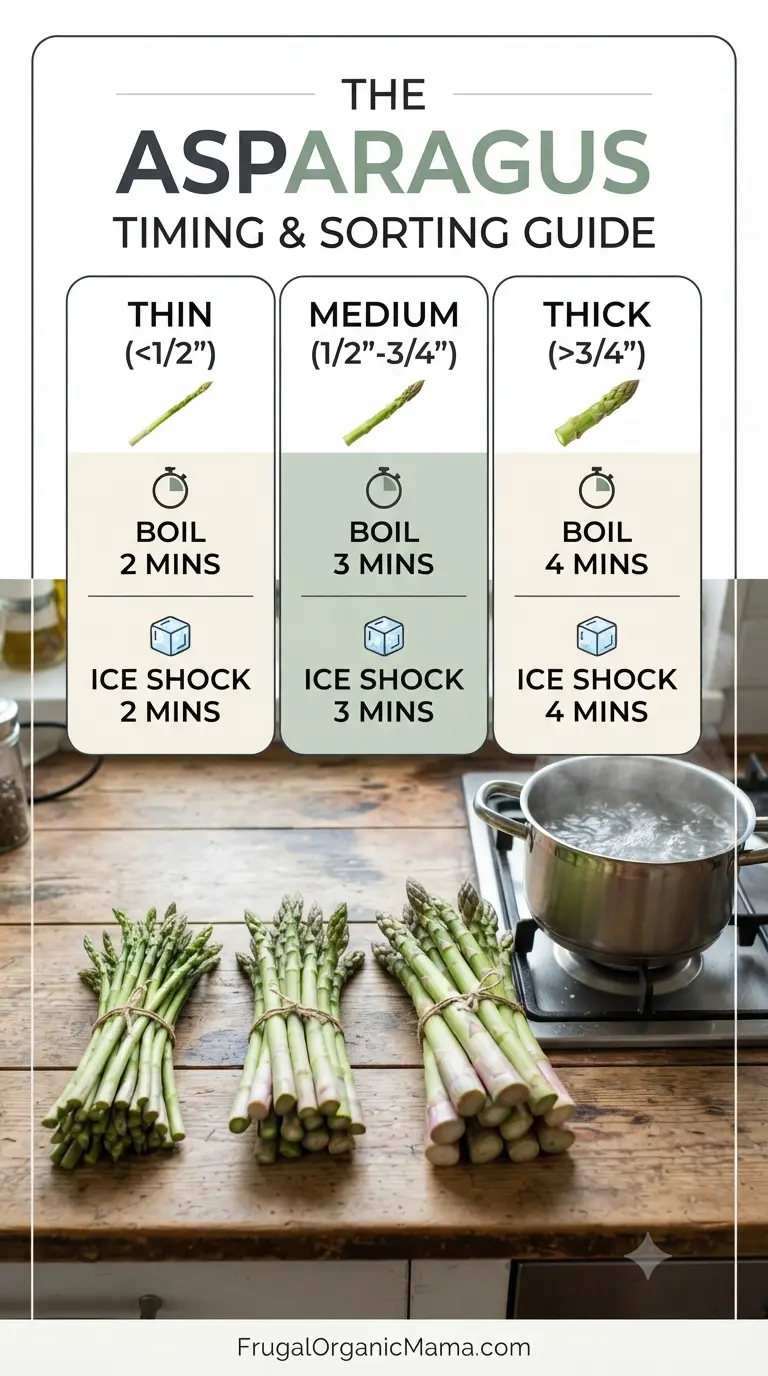
The steam times listed above follow the standard multiplier of 1.5x the boiling time — steam is gentler but slower at transferring heat.
The Step-by-Step Process
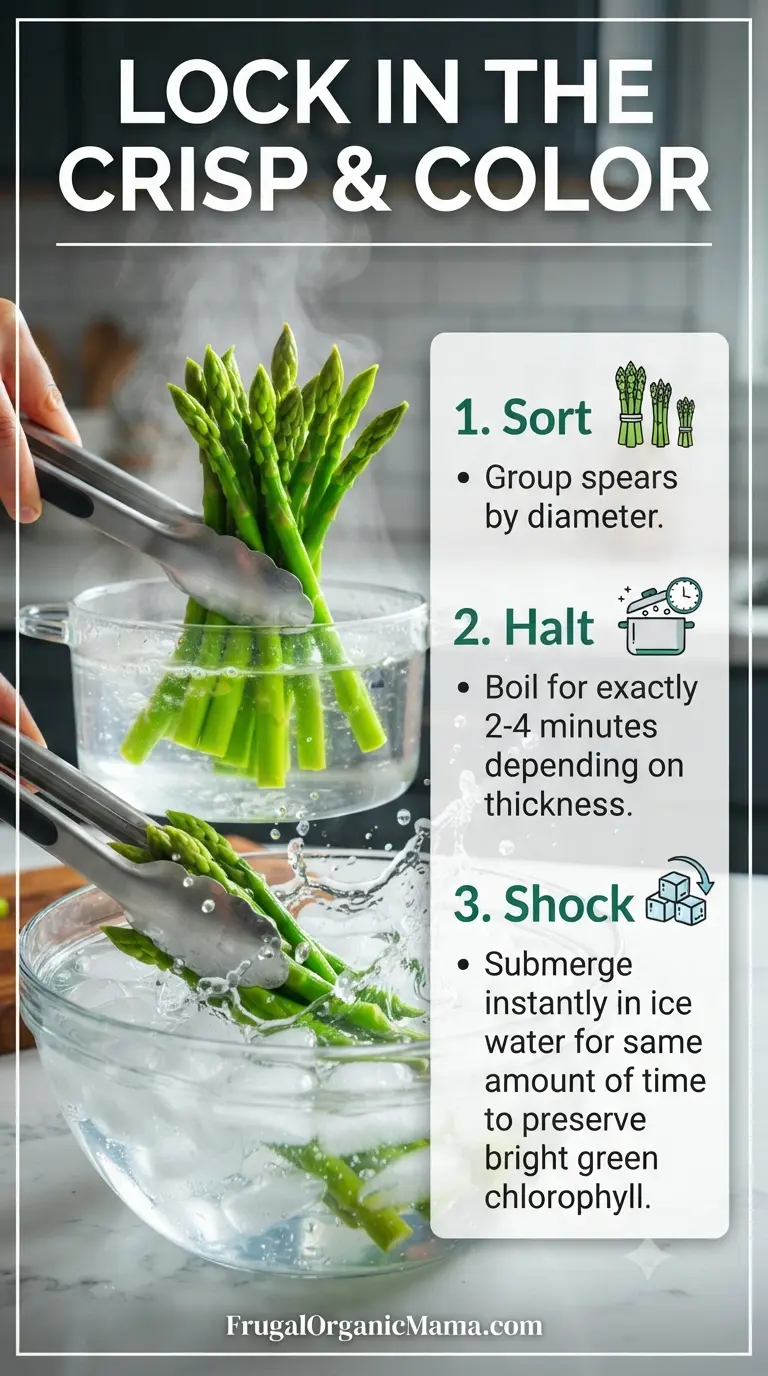
Step 1: Prepare the asparagus Trim the woody ends by bending each spear until it snaps naturally — that's where the tough part ends. I line up the trimmed spears and cut them to uniform length so they cook evenly. For thick spears, I sometimes peel the bottom third with a vegetable peeler to remove the fibrous outer layer.
Step 2: Set up your ice bath Fill a large bowl with cold water and add ice cubes — enough that the water stays cold even after you add hot asparagus. You need roughly equal volume ice and water. I use a 1:1 ratio by volume.
Step 3: Bring water to a rolling boil Use a large pot — at least 6 quarts for a pound of asparagus. The water needs to return to a full boil within 60 seconds of adding the asparagus. Too little water means the temperature drops and your timing becomes unreliable.
Step 4: Blanch by thickness Drop the asparagus into the boiling water and start your timer immediately. Cover the pot to speed the return to boil. Use the exact time from the table above based on your spear thickness. If you live above 3000 feet, add 1 minute to the blanching time because water boils at a lower temperature.
Step 5: Transfer to ice bath Use tongs or a slotted spoon to move the asparagus from the boiling water directly into the ice bath. Leave them for exactly 4 minutes. This stops the cooking process completely.

Step 6: Drain and dry Remove from the ice bath and spread on a clean kitchen towel or paper towels. Pat dry thoroughly. Excess moisture on frozen asparagus causes ice crystal formation and freezer burn.
Comparison: Boiling vs. Steaming vs. Microwave
| Method | Time (Medium Spears) | Texture | Vitamin C Retention | Best For |
|---|---|---|---|---|
| Boiling | 4 minutes | Tender-crisp, uniform | 75-85% | Freezing, large batches |
| Steaming | 5 minutes | Firmer, less waterlogged | 80-90% | Small batches, delicate spears |
| Microwave | 3-4 minutes | Uneven, risk of overcooking tips | 70-80% | Quick prep for immediate use |
For freezing purposes, boiling is the most reliable method. The direct water contact ensures even heat distribution and consistent enzyme inactivation. Steaming works but requires careful positioning and risks uneven results with thicker spears.
Who This Is For
This method is for you if:
- You grow asparagus or buy it in season and want to preserve it
- You meal prep and want blanched asparagus ready for quick sides
- You're new to freezing vegetables and want reliable results
- You've had frozen asparagus turn mushy and want to fix that
This method is not for you if:
- You're only cooking asparagus to eat tonight — just roast or steam it directly
- You're planning to eat frozen asparagus within 2-3 weeks — blanching still helps texture but the margin is wider
- You're working with asparagus that's already past its prime — blanching won't fix old, woody spears
What Not to Do
Don't skip the ice bath. I've seen otherwise careful cooks pull asparagus from boiling water and let it sit on a cutting board while they prep other ingredients. The residual heat continues cooking the asparagus for another 2-3 minutes, pushing it past the ideal texture.
Don't use hot tap water for the ice bath. The ice will melt before the water cools enough to stop cooking. Start with cold water and add ice.
Don't overcrowd the pot. More than 1 pound of asparagus in a 6-quart pot drops the water temperature too much. Work in batches if necessary.
Don't blanch asparagus that's already limp or slimy. Blanching preserves quality — it doesn't restore it. Start with fresh, firm spears.
Don't freeze wet asparagus. Moisture on the surface forms ice crystals that puncture cell walls. Dry thoroughly before freezing.
Final Recommendation
Keep a bag of portioned, blanched asparagus in your freezer at all times. I freeze them in 8-ounce bundles — enough for a side dish for my family of five. When I need a quick vegetable, I pull a bag, run it under warm water for 30 seconds to separate the spears, then sauté in butter for 2 minutes.
The entire process from garden to freezer takes 20 minutes. The payoff is 12 months of asparagus that tastes like you just picked it.
FAQ
Q: Can I blanch asparagus without an ice bath? A: No. The ice bath is the only practical way to stop the cooking process immediately. Running cold water over the asparagus doesn't cool it fast enough — the center stays hot and continues cooking.
Q: How long does blanched asparagus last in the freezer? A: Properly blanched and sealed asparagus maintains acceptable quality for 8-12 months at 0°F. After that, texture and flavor degrade gradually but remain safe to eat indefinitely if kept frozen.
Q: Do I need to trim the woody ends before blanching? A: Yes. The woody ends don't soften during blanching. Trim them before blanching so you're not wasting freezer space on inedible stalks.
Q: Can I blanch frozen asparagus directly without thawing? A: Yes, but add 1-2 minutes to the blanch time. Drop frozen spears directly into boiling water and adjust timing based on thickness. The ice bath time stays the same.
Q: Why does my blanched asparagus turn gray after freezing? A: Gray color indicates over-blanching or incomplete cooling. Check your timing against the thickness table and ensure your ice bath is cold enough — add more ice if needed.
Q: Can I use the blanching water for anything else? A: The water contains water-soluble vitamins and minerals. I use it to water garden plants once it's cooled, or as a nutrient addition to soups and stocks. Don't reuse it for blanching another batch — the temperature recovery time increases.
Related Reading
- How to Blanch Vegetables for Freezing — Universal method covering all vegetables
- How to Blanch Broccoli — 3-minute florets with split timing for stems
- How to Blanch Peas — The narrowest time window of any common vegetable
- How to Blanch Carrots — Size-variant timing for ¼-inch and ½-inch slices
- How to Blanch Green Beans — The vegetable everyone compares to other greens
- Why Blanching Prevents Freezer Burn — The enzyme science behind every blanch
- Blanching Hub — All blanching guides, tool access, and vegetable-specific times in one place