
Suzanne Williamson, RD
Registered dietitian and founder of Frugal Organic Mama. I've navigated three multi-day power outages — one after a winter storm that lasted 68 hours. The decisions I made about what to keep and what to discard weren't guesses. They were based on USDA food safety guidelines, a thermometer, and a clear understanding of which foods have genuine margin and which don't.
⚡ Power restored — ready to cook what you saved?
The defrost calculator helps you plan safe cooking times for meat that thawed during the outage.
A power outage turns your refrigerator and freezer from automatic food safety systems into insulated boxes that are slowly warming up. How quickly they warm — and what you can safely keep — depends on specific variables that most people don't know until they need them.
The frugal instinct is to save as much food as possible. The correct instinct is to save the food that is actually safe to save, and discard the rest without hesitation. The cost of a foodborne illness — the medical bills, the lost work days, the misery — far exceeds the cost of replacing discarded food.
This guide covers the USDA guidelines, the specific time windows, and the detailed food-by-food breakdown for making these decisions correctly.
The Core Numbers
These come directly from USDA Food Safety and Inspection Service guidelines, which are based on research into how quickly different storage environments warm to unsafe temperatures.
| Storage unit | Safe window (door closed) | Why |
|---|---|---|
| Full freezer | 48 hours | Frozen food mass acts as thermal ballast — each frozen item absorbs heat slowly, keeping internal temperature below freezing longer |
| Half-full freezer | 24 hours | Less thermal mass means less cold stored — the air in a half-empty freezer warms faster than frozen food would |
| Refrigerator | 4 hours | Refrigerators maintain 35–40°F, not far below the danger zone. The thermal mass of food helps, but not for long without active cooling |
⚡ The single most important action: keep the doors closed
Every time you open the refrigerator or freezer door during a power outage, you exchange the cold internal air with warm room-temperature air. A 30-second door opening can cost you 20–30 minutes of safe storage time. Decide what you need before opening, get it, and close immediately. If you have a thermometer inside, you can read the temperature without opening at all.
The 40°F / 2-Hour Rule
The food safety danger zone is 40–140°F — the temperature range where bacteria multiply rapidly. The USDA's guidance for perishable food in the danger zone is unambiguous: 2 hours maximum total time above 40°F.
This is cumulative, not per-incident. Food that spent 90 minutes above 40°F during one outage has only 30 minutes of remaining safe margin if it's exposed again.
The 40°F / 2-hour rule applies to:
- All raw meat, poultry, and seafood
- All cooked food
- Dairy products, eggs
- Soft cheeses
- Cut fruits and vegetables
- Any food that would normally require refrigeration
After 2 hours above 40°F: discard, regardless of appearance and smell.
Why Smell Is Not a Safety Indicator
This point is worth stating explicitly because the instinct to smell questionable food is nearly universal — and nearly useless for this purpose.
The pathogens most likely to proliferate during a power outage — Salmonella, E. coli, Campylobacter, Listeria — do not produce noticeable odor at dangerous concentrations. Meat can reach pathogen levels sufficient to cause severe illness and still smell and look completely normal.
Spoilage bacteria (which do cause off-odors) are different organisms from pathogenic bacteria. A piece of chicken that smells fine is not necessarily safe. A piece of chicken that smells slightly off is not necessarily more dangerous than one that smells normal.
The safe/unsafe determination must be made on the basis of time and temperature — not sensory evaluation. As a registered dietitian, this is the guideline I follow regardless of how wasteful it feels in the moment.
The Freezer: What You Can Actually Save
When power is restored — or when you have access to dry ice or a generator — assess each item individually based on its current state, not elapsed time alone.
Safe to refreeze (still contains ice crystals, or still 40°F or below):
These foods have not fully thawed and have not entered the danger zone. They can be refrozen immediately, though quality will decline (texture is affected by the freeze-thaw cycle):
- Meat, poultry, seafood — if still partially frozen with ice crystals
- Vegetables and fruits — if still partially frozen
- Bread, pastries, waffles, bagels
- Juice concentrates
- Ice cream — if it still contains solid crystals (fully melted ice cream should be discarded, not refrozen)
- Hard cheeses
- Casseroles, stews, soups — if still containing ice crystals
Cook immediately, do not refreeze:
These have thawed but have been above 40°F for less than 2 hours. Cook to a safe internal temperature and use immediately, or cook and then refreeze the cooked product.
- Meat and poultry that are thawed but still cold
- Seafood that is thawed but still cold
- Cooked dishes that are thawed but still cold
Discard — do not taste, do not cook:
These have been above 40°F for more than 2 hours or show signs of full thaw with no temperature certainty:
- Any meat, poultry, or seafood that is fully thawed and room temperature
- Soft cheeses (cottage cheese, ricotta, brie)
- Opened canned meats or fish
- Casseroles and cooked dishes that are fully thawed and warm
- Ice cream that is fully melted
- Egg products that have thawed
The Refrigerator: The 4-Hour Window
The refrigerator is the more urgent concern during an outage because it has much less time margin than the freezer.
After 4 hours without power (door kept closed), assume the internal temperature has exceeded 40°F. At this point, apply the 2-hour rule to everything inside: any perishable food that has been above 40°F for more than 2 hours total must be discarded.
What you must discard from the refrigerator after the 4-hour window:
| Food category | Specific items — discard if above 40°F for 2+ hours |
|---|---|
| Meat, poultry, seafood | Raw or cooked — all types, all cuts |
| Dairy | Milk, cream, soft cheeses, yogurt, sour cream, opened cream cheese |
| Eggs | Raw eggs out of shell, hard-boiled eggs, egg dishes |
| Cooked food | Casseroles, stews, soups, pasta dishes, potato dishes, rice dishes |
| Sauces and gravies | Meat-based gravies, cream sauces, opened broth |
| Fresh pasta and dough | Fresh pasta, pizza dough, biscuit dough |
What is generally safe from the refrigerator:
These foods have sufficient acidity, salt, or low water activity to be stable without refrigeration for the typical outage duration:
- Hard cheeses (cheddar, parmesan, romano) — whole blocks can be wiped of any surface mold and are safe
- Butter and margarine
- Opened fruit juices and vegetable juices
- Fresh whole fruits and vegetables (uncut)
- Fruit — opened canned or fresh cut fruit is good for only 2–4 hours
- Peanut butter, jelly, jam
- Vinegar-based condiments (mustard, ketchup, relish, pickles, olives)
- Bread, rolls, cakes, muffins
- Breakfast cereals and granola
- Fruit pies (not cream pies)
- Fruit or nut pastries
How to Extend Your Safe Window
If you have warning that a power outage is coming (before a storm, for example), there are practical steps that extend your safe window:
Fill the freezer. An empty freezer has no thermal mass. Fill empty space with bags of ice, containers of water frozen solid, or simply more food. A full freezer holds temperature nearly twice as long as a half-empty one.
Turn the freezer colder. Set the freezer to 0°F or below before the outage. Starting colder gives you more margin before food reaches the danger zone.
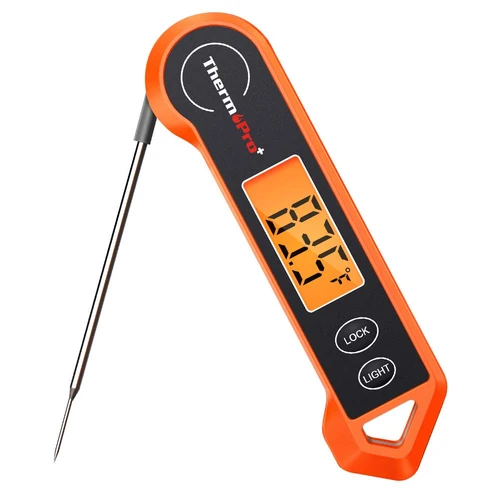
Get a freezer thermometer. A simple dial thermometer inside the freezer lets you check temperature without opening the door during an outage. This single tool removes all guesswork — you know exactly what temperature food has been at. A dual-display thermometer with a probe inside and a display outside is ideal.
Dry ice. 25 pounds of dry ice will keep a full 10-cubic-foot freezer cold for 3–4 days. Handle with insulated gloves — dry ice is -109°F and causes immediate frostbite. Place on top of frozen food (cold air falls). Keep the area ventilated — CO₂ buildup from subliming dry ice is a real risk in small enclosed spaces.
Block ice. Regular ice in the refrigerator can extend safe temperature for an additional 2–3 hours. It melts and requires a container underneath, but it buys meaningful time.
Coolers. A well-insulated cooler packed with ice and prioritized refrigerator items (meat, dairy) can hold safe temperatures for 24–48 hours with enough ice. This is often the practical answer for the refrigerator when the outage extends past 4 hours.
After Power Is Restored: The Assessment
When power comes back, don't immediately assume everything is fine. The assessment:
For the freezer: Check each item for ice crystals. If items still have ice crystals or feel cold (40°F or below), they are safe to refreeze or continue using. If items are fully thawed, apply the 2-hour rule — if you cannot determine how long they were above 40°F, discard.
For the refrigerator: If the outage was 4 hours or less with the door kept closed, the refrigerator is likely still within safe range. If longer, apply the discard guidelines above. If you have a thermometer reading, use that to make the determination directly — any reading above 40°F for items that require refrigeration means applying the 2-hour rule.
Document what you discard. Homeowners insurance and renters insurance often cover food spoilage from power outages. Keep a list of what you discarded and estimated values. Many policies have a specific food spoilage rider or provision — it's worth checking your policy before an outage, not after.
The Frugal Calculation
Discarding food after a power outage feels expensive in the moment. The actual math makes it easier to decide correctly:
A typical family's refrigerator contents represent $100–200 in food. A single case of foodborne illness from Salmonella or E. coli produces an average of $3,000–5,000 in medical costs for a moderate case, plus lost work time, plus significant misery. A severe case requiring hospitalization is far more costly.
The economically correct decision in almost every scenario is to discard food that cannot be verified as safe. The frugal choice is not to push limits — it's to prevent a much more expensive outcome.
What this means practically: If you're uncertain whether food is safe — if you didn't track the time, if you don't have a thermometer, if you're not sure how long the outage lasted — discard it. The replacement cost is the lesser expense.
Power restored and planning dinner?
If you have partially thawed meat that's still safe to cook, the defrost calculator helps you plan the timing.
Related Reading
- All Food Safety Guides — The full food safety cluster: danger zone, power outage, and shelf life
- Food Safety Danger Zone Guide — The 40–140°F range where bacteria multiply and how to manage it
- How Long Do Spices Last? — Shelf life guidelines for pantry staples during and after outages
- Best Way to Defrost Meat — Safe thawing methods once power is restored