
Sarah Chen, Food Safety & Preservation Editor
Food scientist and fermentation specialist who reviews and validates all food safety content, preservation guides, and USDA guideline interpretations on Frugal Organic Mama. I treat a head of cauliflower as a chemistry question — cut size controls surface area, minutes control enzyme deactivation, and the ice bath controls residual heat.
You pull a bag of frozen cauliflower out of the freezer, expecting crisp white florets ready to roast. Instead, you find a grey, weeping, mushy mess. It smells faintly sour and looks like it gave up on life somewhere around week three. Most home cooks blame the freezer. Or the variety. Or convince themselves cauliflower just "doesn't freeze well."
Here's the first thing you need to know: it's never the freezer's fault, and it's never the cauliflower's. It's enzyme chemistry. And it's fixed by one precise cut size and two exact 3-minute stages. The exact single-vegetable numbers — and the full blanching time chart for every common vegetable — live in our How to Blanch Vegetables (USDA Time Chart).
When you get those numbers right, that head of cauliflower you bought for 99 cents in peak season becomes an 8-to-12-month freezer staple — crisp, mild, and ready to roast straight from the bag. Get them wrong, and you've wasted the money, the time, and a perfectly good vegetable.
The good news? The fix is embarrassingly simple. You just need to stop guessing and start measuring.
Why Blanch at All: The Enzyme Problem Nobody Tells You About
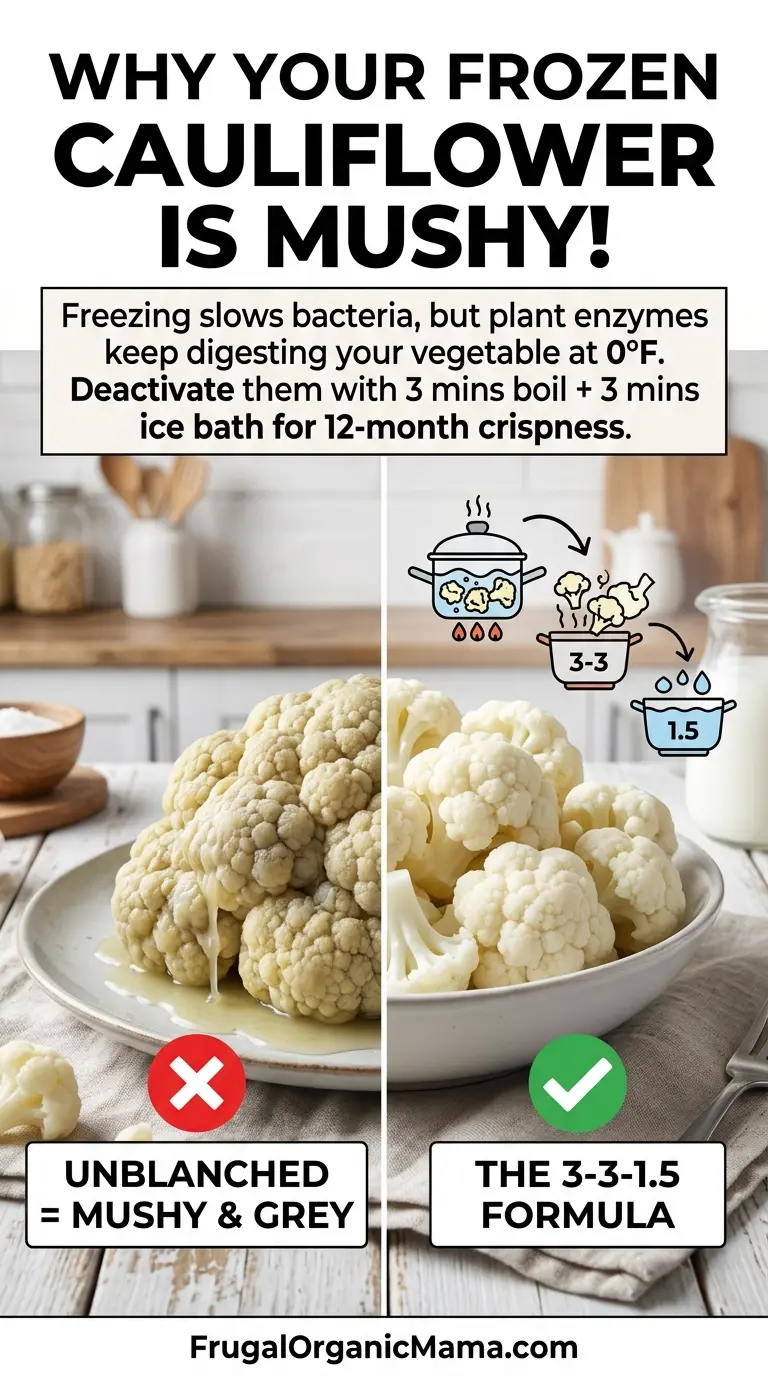
Here's what most guides skip: cauliflower doesn't go bad in the freezer because of bacteria. It goes bad because of enzymes — and those enzymes keep working even at 0°F.
Freezing slows down spoilage microorganisms, but it doesn't stop the plant's own biochemistry. Cauliflower contains enzymes that stay active at freezer temperatures, slowly breaking down the vegetable's natural compounds. The result is that bitter, slightly sour, "off" flavor and that unappetizing yellow-grey color you find months later. It's not freezer burn. It's not oxidation. It's the cauliflower essentially digesting itself, very slowly, in the dark. If you want the full biochemistry of why blanching stops this, see Why Blanching Prevents Freezer Burn.
Blanching fixes this by heat. Dropping the florets into rolling boiling water for a short, precise time deactivates those enzymes — a process food scientists call enzyme inactivation. Once the enzymes are dead, the cauliflower's chemistry stops. The freezer becomes a true pause button instead of a slow-motion spoiler.
And that's why the ice bath matters just as much as the boil. Heat deactivates the enzymes, but cold stops the heat — and if you skip the cold-water stop, the residual heat keeps cooking the florets into mush. It's not that you skipped the ice bath to save time; it's that skipping it lets the cell walls soften and collapse, then freeze into a soggy mess.
One more thing worth understanding: blanching also brightens the color, sets the texture, and removes surface dirt and microorganisms. It's doing four jobs at once. None of them are optional.
The 3-3-1.5 Formula
Here's the number set you need to memorize:
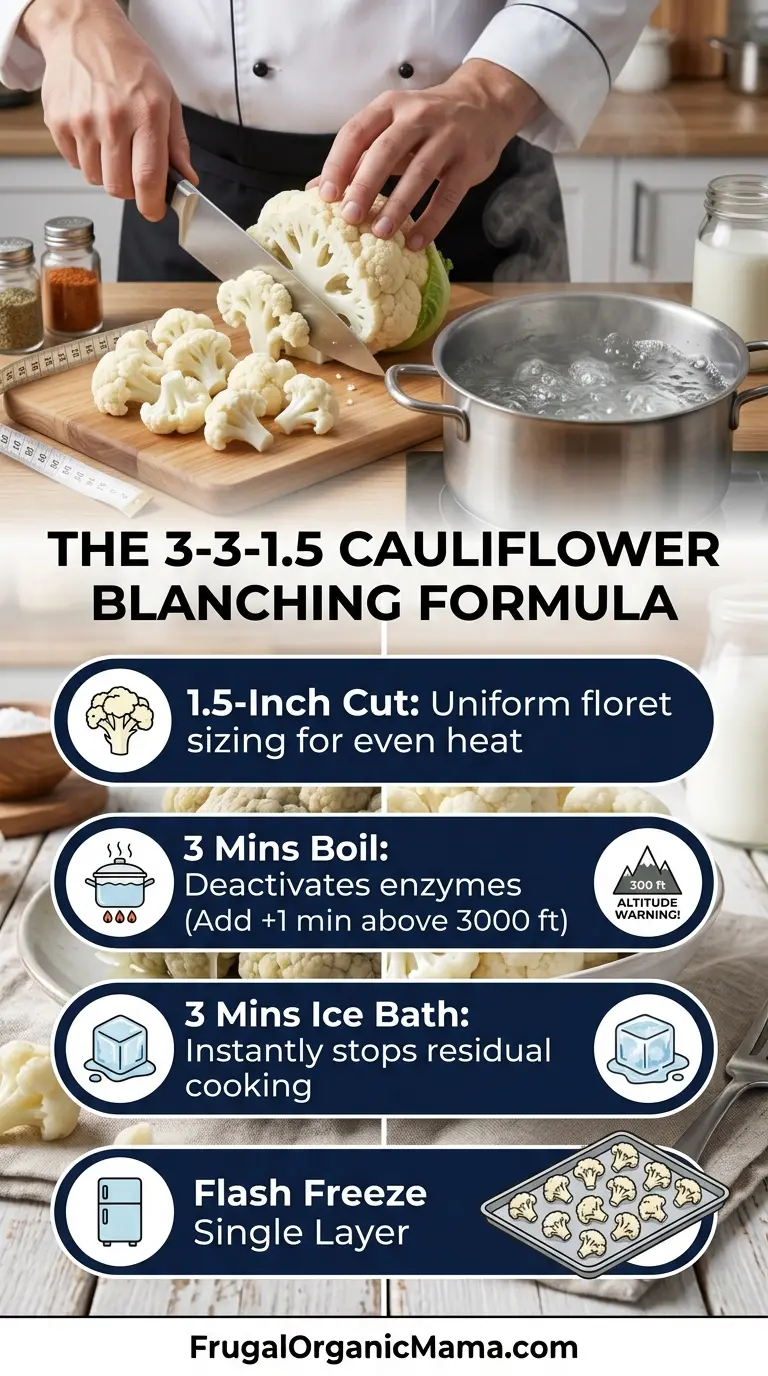
3 minutes boiling. 3 minutes ice bath. Florets cut to 1.5 inches.
That's it. Two 3s and a half. Get the 3-3-1.5 and your cauliflower keeps for up to a year; guess and you get grey mush that tastes like it froze a month ago.
| Step | Time | Cut size |
|---|---|---|
| Boil (rolling water) | 3 min | 1.5-inch florets |
| Ice bath | 3 min | — |
| Above 3000 ft | add 1 min to the boil | — |
These aren't numbers I invented. The USDA's own blanching guidelines — the same tables used in the USDA Complete Guide to Home Canning and the National Center for Home Food Preservation (NCHFP) resources — specify 3 minutes in boiling water for 1.5-inch cauliflower florets, followed by the same 3 minutes in an ice bath. This is the authoritative number, and it's the number most food blogs shrug past.
The English-speaking internet is full of contradictory "4 to 5 minutes" timings, usually written by someone who blanched cauliflower once, guessed, and shared their guess as gospel. You have permission to trust a government agency's tested science over a food blog's shrug. The USDA's numbers exist precisely because home cooks kept getting this wrong — and because under-blanching and over-blanching both ruin what should be a frugal win.
One adjustment for altitude: if you live above 3000 feet, water boils at a lower temperature, so you need to add 1 minute to the boiling stage. At altitude: 4 minutes. Everything else stays the same.
🥦 Lock in the exact 3-minute timer for your batch?
The blanching timer covers cauliflower plus 25+ other vegetables — with ice bath alerts and altitude adjustments built in.
Prep: The Cut Size Is the Control Variable
Before any water heats, the cutting board is where precision starts.
Cut the cauliflower into florets that are 1.5 inches across — roughly bite-size. I know this feels fussy. But the cut size is not cosmetic: it controls surface area, and surface area controls how fast heat penetrates the floret. Cut too large, and 3 minutes of boiling won't reach the center of the stem — the enzymes there survive, and the veg still turns bitter in the freezer. Cut too small, and 3 minutes turns the florets into paste.
1.5 inches is the sweet spot precisely because it's small enough to blanch uniformly in exactly 3 minutes, yet large enough to survive freezing and thawing without collapsing. The USDA chose that size for a reason. Trust it.
Remove the outer leaves and trim the thick core stalk — the woody part that won't cook evenly. Rinse the florets well to knock off any dirt or garden residue. Then, and this is critical:
Prepare the ice bath before the water even starts boiling.
Fill a large bowl with equal parts ice and cold water — you want it visibly icy, not merely cool, with the water temperature at or below 40°F. Why before? Because once those florets come out of the boiling water, you have seconds to get them cold. If you're scrambling to fill a bowl with warm tap water while your cauliflower sits steaming in the colander, the residual heat is already doing damage.
And use enough boiling water: at least 1 gallon of water per pound of cauliflower. Adding a pound of room-temperature florets to a too-small pot kills the boil instantly, and you end up simmering instead of blanching. A generous pot maintains the rolling boil that makes the timing work.
The Boil: Start the Timer on the Re-Boil
Drop the florets into the boiling water, and then — this is the step almost everyone gets wrong — wait for the water to return to a full rolling boil before you start the 3-minute timer.
The timer starts on the re-boil, not on entry.
When you add room-temperature cauliflower to boiling water, the water temperature drops. If you start counting the moment the florets hit the pot, you're counting dead time. The actual blanching only truly begins when the water is back at a hard, rolling boil — which can take a minute or more depending on how much cauliflower you added. Start early, and you under-blanch. Every single time.
So: add the florets, wait for that full boil to return, then set the timer for 3 minutes. Keep the heat high. It should be at a hard, active boil the whole time — not a gentle bubble, but a proper rolling one.
If you're at altitude above 3000 feet, set the timer for 4 minutes instead. It's the only change to the formula.
The Ice Bath: Not Optional, Not Shortened
The boiling timer dings. Now you move fast.
Immediately transfer the florets to the ice bath — a slotted spoon works well — and let them sit for the full 3 minutes. Same duration as the boil, deliberately. This is not a quick dip. It's the second half of the enzyme equation: the ice bath stops the cooking process instantly, preventing the residual heat from breaking down the cell walls into mush.
Equal time in, equal time out. That symmetry matters.
After 3 minutes in the ice bath, drain thoroughly. Then — and I can't emphasize this enough — pat the florets completely dry. Use a clean kitchen towel or lay them out on layers of paper towels and roll them gently. Surface moisture is the enemy. Water on the outside of a floret forms ice crystals during freezing, and those crystals cause freezer burn, clumping, and that sad, frostbitten texture people blame on "old" vegetables.
The florets should look dry before they go anywhere near the freezer.
Dry, Flash-Freeze, Bag
Now the freezer workflow, in the right order:
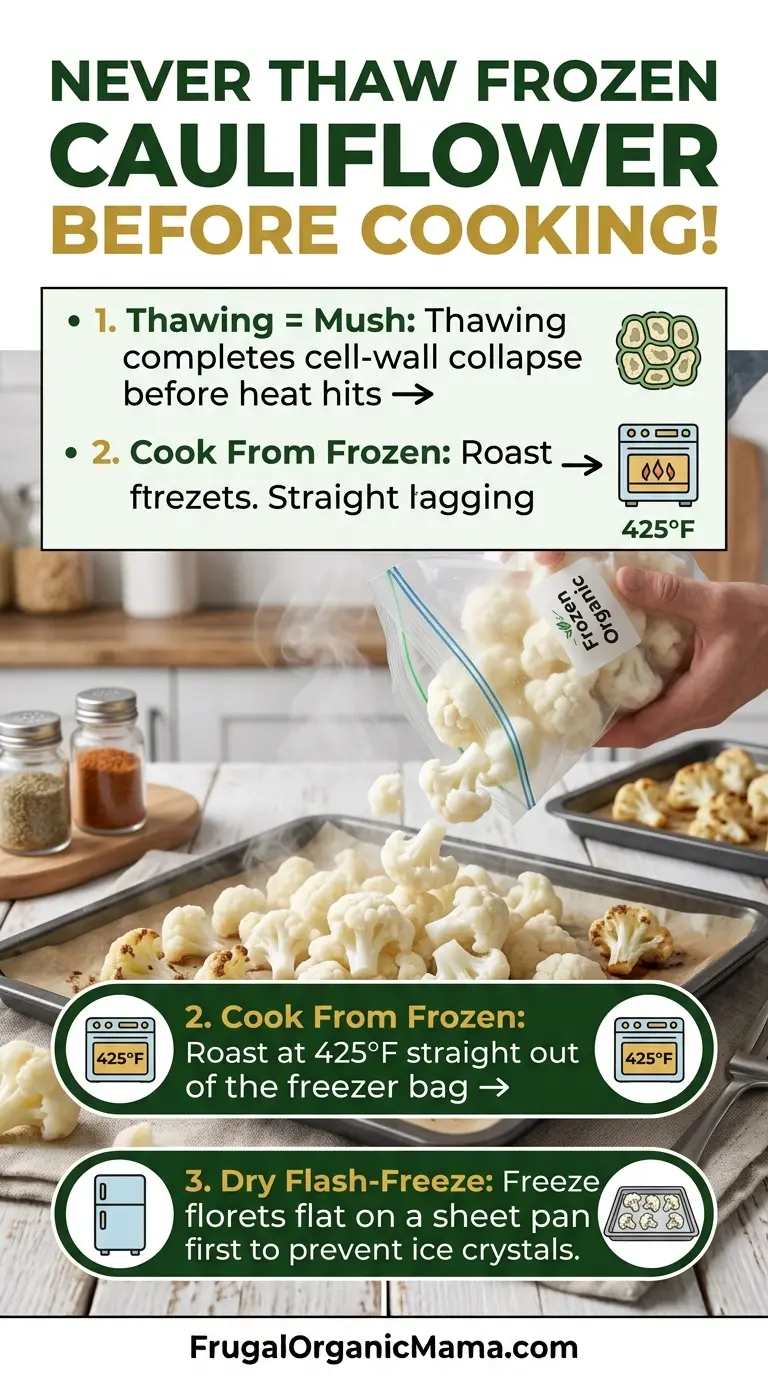
Flash-freeze. Lay the dry florets in a single layer on a sheet pan lined with parchment paper. Make sure they're not touching. Pop the pan into the freezer for 1 to 2 hours, until the florets are individually frozen solid.
Bag. Transfer the frozen florets into airtight freezer bags or containers, squeeze out as much air as possible, and seal. Label with the date — trust me, you'll forget by spring.
Freeze at 0°F. A freezer that holds a true 0°F is what makes the 8-to-12-month shelf life possible.
Never bag florets that are still warm or wet. Warm florets steam inside the bag, creating condensation, which means ice crystals, which means clumping and freezer burn. The flash-freeze step exists specifically to prevent this. It's a small delay that saves the whole batch.
For the full 25-crop storage workflow — including how to freeze cauliflower alongside everything else in your garden harvest — see How to Freeze Garden Vegetables (25 Crops).
How Long Does Frozen Cauliflower Actually Keep?
Here's the honest answer: frozen cauliflower is safe to eat indefinitely as long as it stays solidly frozen at 0°F. Freezing halts microbial growth, so spoilage organisms can't do their thing. But safety and quality are two different conversations.
For best quality, plan to use your frozen cauliflower within 8 to 12 months. That's the standard window for properly blanched vegetables. Within that window, the color stays bright, the texture holds its structure, and the flavor remains clean and mild.
Unblanched cauliflower, by comparison, degrades within 1 to 2 months — visible to anyone who's pulled a sad grey bag out in February. That's the difference a single 3-minute boil makes. Blanch it, and you buy yourself almost a year of quality. Skip it, and you've got a month or two of deteriorating mush.
And if you notice your frozen cauliflower has been in there longer than a year? It's not dangerous — but don't expect it to roast up crisp. Plan for soups and cooked dishes where texture matters less.
Cooking From Frozen: Don't Thaw First
This is the trick that makes frozen cauliflower actually useful: never thaw it before cooking.
Thawing is what turns frozen cauliflower into mush. The ice crystals that formed during freezing have already slightly damaged the cell walls; thawing completes that breakdown, releasing water and leaving you with a soggy, weeping vegetable. Cook from frozen instead.
Roasting: Toss the frozen florets with oil, salt, and whatever seasonings you like, spread them on a sheet pan, and roast at 425°F. Add about 5–7 extra minutes compared to fresh cauliflower. They'll brown up nicely — the edges get crispy while the interior stays tender.
Steaming or boiling: Drop the frozen florets directly into the pot and add a couple of extra minutes. No need to adjust for thawing.
Soups, curries, and stir-fries: Add frozen florets straight to the pan or pot. They'll cook through in minutes.
The key is that you're using the frozen state as an advantage, not working against it. This is also why flash-freezing matters: individually frozen florets cook evenly from frozen, while a clumped mass of stuck-together cauliflower cooks unevenly and turns to paste on the outside before the center thaws.
The Frugal Case: The Freezer as a Pantry
Here's the cultural context that makes all of this worth doing: Western home cooks tend to treat frozen vegetables as a sad fallback — a compromise when fresh isn't available. But the frugal-preservation tradition treats the freezer as a pantry. A head of cauliflower bought at a seasonal low — 99 cents, or pulled from the garden when the heads are at their best — becomes cheap, ready-to-cook florets all winter long.
That's exactly why precision matters. A full failed head is wasted money. And because re-freezing thawed cauliflower is a quality and safety no-go — the texture collapses on the second freeze, and the temperature fluctuation invites the kind of handling that food safety experts never endorse — you need to get the first freeze right.
One head, prepped properly, costs you about 15 minutes of focused work. Those 15 minutes give you pounds of vegetable protein, fiber, and vitamin C at a fraction of winter grocery-store prices. The math only works if every floret survives.
The One Rule to Remember
Let me leave you with the whole article compressed into a single decision rule. Frozen cauliflower is right when you match three numbers:
- CUT — florets to 1.5 inches, so they blanch evenly but survive freezing.
- BOIL — exactly 3 minutes in rolling boiling water, with at least 1 gallon of water per pound, starting the timer only when the water returns to a full boil.
- ICE — immediately into a genuinely icy water bath for the same 3 minutes, then drain, pat fully dry, flash-freeze on a sheet pan, and bag.
Above 3000 feet, add 1 minute to the boil. Never re-freeze thawed cauliflower.
Two 3s lock in perfect frozen cauliflower: 3 minutes boiling, 3 minutes ice bath, florets cut to 1.5 inches. Heat deactivates the enzymes. Cold stops the heat. And the numbers — for once, in a world of vague food-blog shrugs — are not optional.
The USDA did the science so you don't have to guess. All you have to do is follow the numbers. Your future self, pulling crisp white florets out of a January freezer, will thank you.
Frequently Asked Questions
How long do you blanch cauliflower? Blanch 1.5-inch florets for 3 minutes in rolling boiling water, then 3 minutes in an ice bath. Above 3000 feet, add 1 minute to the boil.
Do you need to blanch cauliflower before freezing? Yes. Cauliflower's enzymes degrade it at freezer temperature; blanching deactivates them. Unblanched cauliflower turns grey, bitter, and mushy within 1 to 2 months. Blanched florets keep best quality for 8-12 months.
Can you freeze cauliflower without blanching? You can, but it won't keep. Expect noticeable degradation within 1 to 2 months — the difference a single 3-minute blanch makes.
Do you blanch cauliflower in steam or water? Water. The USDA data layer lists water-blanch only for cauliflower — there is no steam time for it. (Some vegetables, like mushrooms, are the opposite. See How to Blanch Mushrooms.)
Do you thaw cauliflower before cooking from frozen? No — cook from frozen, never thaw first. Roast at 425°F, steam, or stir-fry straight from the bag and add a few extra minutes.
🥦 Never guess a blanch time again?
Get the exact boil and ice-bath minutes for cauliflower and 25+ vegetables — with ice bath alerts and altitude adjustments.
Related Reading
- How to Blanch Vegetables (USDA Time Chart) — The master chart this cauliflower guide is part of
- How to Blanch Broccoli — The nearest sibling: same 1.5-inch cut, same 3-3 discipline
- How to Freeze Garden Vegetables (25 Crops) — The full garden-to-freezer workflow
- Why Blanching Prevents Freezer Burn — The enzyme science behind every blanch
- How to Blanch Green Beans — The vegetable everyone compares cauliflower's siblings to
- Blanching vs Steaming — Why cauliflower is water-blanched, not steamed
- Blanching Hub — All blanching guides, tool access, and vegetable-specific times in one place